Vytautas Carr
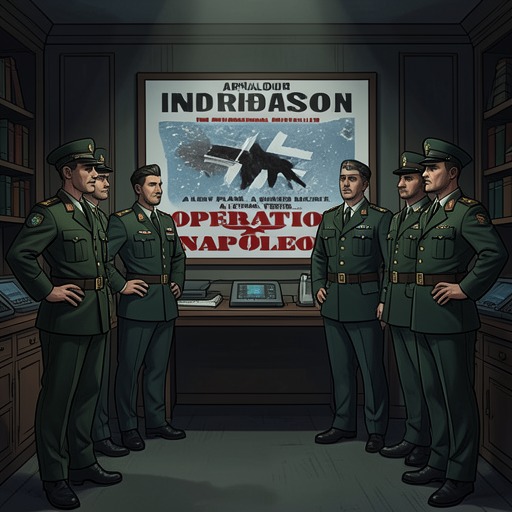
Operation NapoleonVytautas Carr’s defining role is to inherit and enforce a secret: a German aircraft buried in Vatnajökull, and the procedure for dealing with it if it is found. As director of Building 312 intelligence service, he brings military discipline to the discovery, protects the operation through force and misinformation, and ultimately argues that history itself is an instrument of power. His composure makes him an effective custodian of the secret, but his final encounter with Kristín exposes the bleak principle beneath that composure: for Carr, truth is subordinate to the outcome he seeks.
Identity and Background
Carr is a career soldier whose life and professional identity were shaped by war and intelligence work. His parents emigrated from Lithuania to the United States in the 1920s; born with the surname Karilius, he shortened it to Carr as he sought to integrate into his adopted country. An only child, he was eleven when the United States entered the Second World War and followed reports from the front closely. He joined the army as soon as he was old enough, rose quickly through its ranks, and served as a liaison officer to the North Atlantic Treaty Organization. Desk work did not suit him: when the Korean War began, he transferred to active duty, helped establish a covert operations service, and undertook missions behind enemy lines. He later joined army intelligence.
By the time the novel presents him as director of Building 312 intelligence service, Carr is approaching seventy and remains in office by special dispensation. Nearly six foot five and still ramrod straight, he wears civilian clothes rather than a uniform in the control room, but his bearing and habits remain those of a soldier. He has spent much of his career directing and shaping the organization, whose work began during the Cold War with the analysis of satellite photographs of the Soviet Union, China, Cuba, and other perceived adversaries. Its later remit includes monitoring terrorist bases in the Middle East and conflicts in the Balkans. From a converted warehouse near the Capitol in Washington, D.C., the service controls eight satellites in orbits between 800 and 1,500 kilometres above Earth.
The Discovery and an Inherited Secret
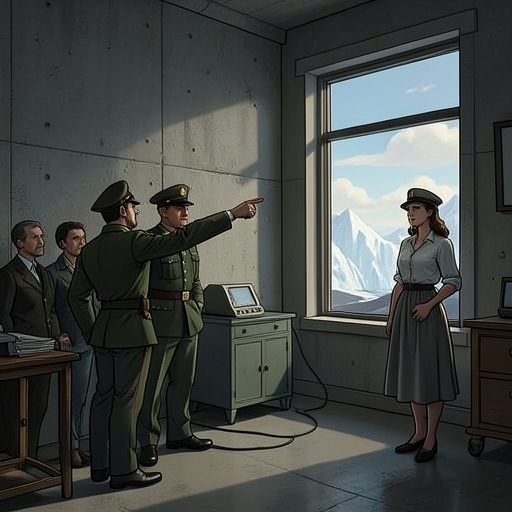
Carr’s introduction places him before a wall-sized monitor in Building 312’s first-floor control room. Armed guards stand at the doors; four banks of screens and control panels divide the room, while the fans for twelve powerful computers keep it cool. One screen displays archived satellite photographs, drawn from tens of millions of images collected over four decades. Beside it, a new image of south-east Iceland’s Vatnajökull is compared with a photograph taken about a year earlier. The older view shows only the familiar white ice and crevasses. In the new one, a small dark mark interrupts the glacier. Carr orders an enlargement, watching the indistinct mark resolve across the screen.
The discovery is not new to him in the deeper sense. Carr inherited knowledge of the aircraft in the early 1970s, when he took over as chief of the organization. His predecessor spent five years gradually explaining the background, what the plane carried, and what to do if it were found. Carr learned enough to follow a procedure that he reviewed every few years, although even he did not know the whole story. For fifty-four years, knowledge of the plane and the response plan had been confined to a handful of senior army figures, passed from one officeholder to the next. The secrecy is thus both personal inheritance and institutional continuity; Carr understands that disclosure could have consequences severe enough that he does not want to imagine them.
The physical proof is a wheel bearing the inscription Kruppstahl. Carr takes it from a glass cabinet and weighs it in his hands, recalling how long it has been since he examined it. The wheel’s make fits the aircraft’s type and size, its year of manufacture, and its capacity. To Carr, it confirms the crash-landing and establishes that the aircraft is indeed on the glacier. Its rediscovery activates the carefully rehearsed procedure. When Ratoff asks whether the coordinates remain the same, Carr explains that this is a new location: the glacier keeps moving. His abrupt, businesslike exchange with Ratoff also makes clear that operational necessity does not amount to trust.
Command, Secrecy, and Control
Carr’s response reaches beyond the satellite room. When the defense secretary challenges him over a plane at Keflavík, the cost of deploying a C-17 transport plane and Delta Force, and Ratoff’s fitness to serve, Carr initially offers no answer. Under normal procedures, the secretary should not even know that men like Ratoff exist. Instead, Carr places satellite images of Vatnajökull before him. The exchange shows how Carr manages information as part of command: he withholds what he can, reveals what he chooses, and makes the crisis legible to political authority on his own terms. Their meeting eventually leaves the secretary more appreciative of the secret service, while Carr takes private satisfaction in having brought him to heel.
His relationship with Ratoff is similarly shaped by hierarchy and instrumental use. Carr summons him to Keflavík without preamble, then directs him through the response to the new discovery. Yet Carr does not mistake obedience for personal loyalty. Later, aboard the aircraft, he listens to Ratoff’s screams until the engines drown them out and concludes that Ratoff has finally given in. Carr does not ask what has been done to him and regards the details as irrelevant; in his assessment, the combination of drugs and physical torment makes resistance futile. The scene shows the human cost of the operation through Carr’s refusal to dwell on it. His attention stays on completion, not compassion.
The Final Encounter and Carr’s View of History
Carr describes the glacier assignment to himself as his last one. Looking out into the night from the flight cabin, he thinks he will retire when it is over. He has spent his life waiting to close this chapter, which he regards as a footnote left over from the war years—forgotten by the world and no longer of interest to anyone. That wish for closure gives the operation a personal dimension, but it does not soften his commitment to secrecy: the chapter must be closed on the terms set by the institution that inherited it.
After Ratoff is taken from the hold, Carr approaches Kristín in his US general’s uniform, accompanied by three men. He promises that she will be sent home to Iceland once the American personnel and their equipment have left. She may speak to the authorities, press, family, and friends, he says in substance, but he doubts she will be believed because misinformation about the mission is already being circulated. He also gives her concrete assurances: Júlíus, the glacier rescue team’s leader, is safe and will be put down outside the base gates, and her brother Elías is alive and in a Reykjavík hospital. These disclosures offer Kristín some relief, but they also reveal the limits of Carr’s reassurance. He is willing to confirm lives and locations while ensuring that the larger account of events will be contested and obscured.
When Kristín demands to know the truth, Carr rejects the idea that truth is an independent standard by which the operation should be judged. He calls the work a correction of historical mistakes and insists that the past is irrelevant to present purposes. His examples deliberately unsettle familiar certainties: he invokes Neil Armstrong’s visit to Iceland to question whether anyone can prove the moon landing occurred as reported, then raises the Kennedy assassination, the Vietnam War, and Stalin’s death toll. The point is not to establish an alternative account of those events, but to make uncertainty serve his argument that history can be reinvented. Carr’s claim that there is no such thing as truth turns secrecy from a temporary tactic into a worldview. The satellite images that first made him alert to a mark on the ice promise exact observation; by the end, the man who trusts those images tells Kristín that evidence itself cannot secure a stable past. That contrast defines his narrative significance: he is both the guardian of a material secret and an advocate for the political manufacture of what the world will believe.